Plant Disease Detection with Deep Learning
A machine learning project for automated analysis of plant leaves
Plants and trees form the foundation of agriculture – and at the same time they are highly susceptible to diseases that can drastically affect both yield and quality. Even worse: wrong diagnoses often lead to excessive or incorrect pesticide use, increasing costs and harming the environment.
Together with my team, I developed a system that uses Deep Learning to reliably detect plant diseases—optimized for embedded systems, drones, and automated agricultural processes.
Project Overview
Our goal was to develop an efficient, lightweight, and robust classification model for plant diseases. The focus was on:
- Transfer Learning using modern lightweight architectures
- High generalization capability despite varying image sources
- Easy integration into automation systems and UAVs (e.g., drones)
The result is a customizable framework capable of delivering diagnostics in near real-time.
Our Approach: Transfer Learning & Fine-Tuning
We built the core of our system using Transfer Learning. Instead of starting from scratch, we leverage the knowledge of pretrained models and finetune them for our specific problem.
Models Used
- MobileNetV2 (3.5M parameters)
- EfficientNet-B0 (5.3M parameters)
- For comparison: ResNet50 (25.6M parameters – too large for embedded systems)
These models offer:
- Very high efficiency
- Low parameter count
- Good performance on smaller devices (Edge AI)
Evaluation with a Confusion Matrix
To evaluate the model's performance meaningfully, we used a confusion matrix, which clearly shows how well real and misclassified cases were detected.
Here you can see the confusion matrix plot of our MobileNetV2 after the 2nd training epoch:
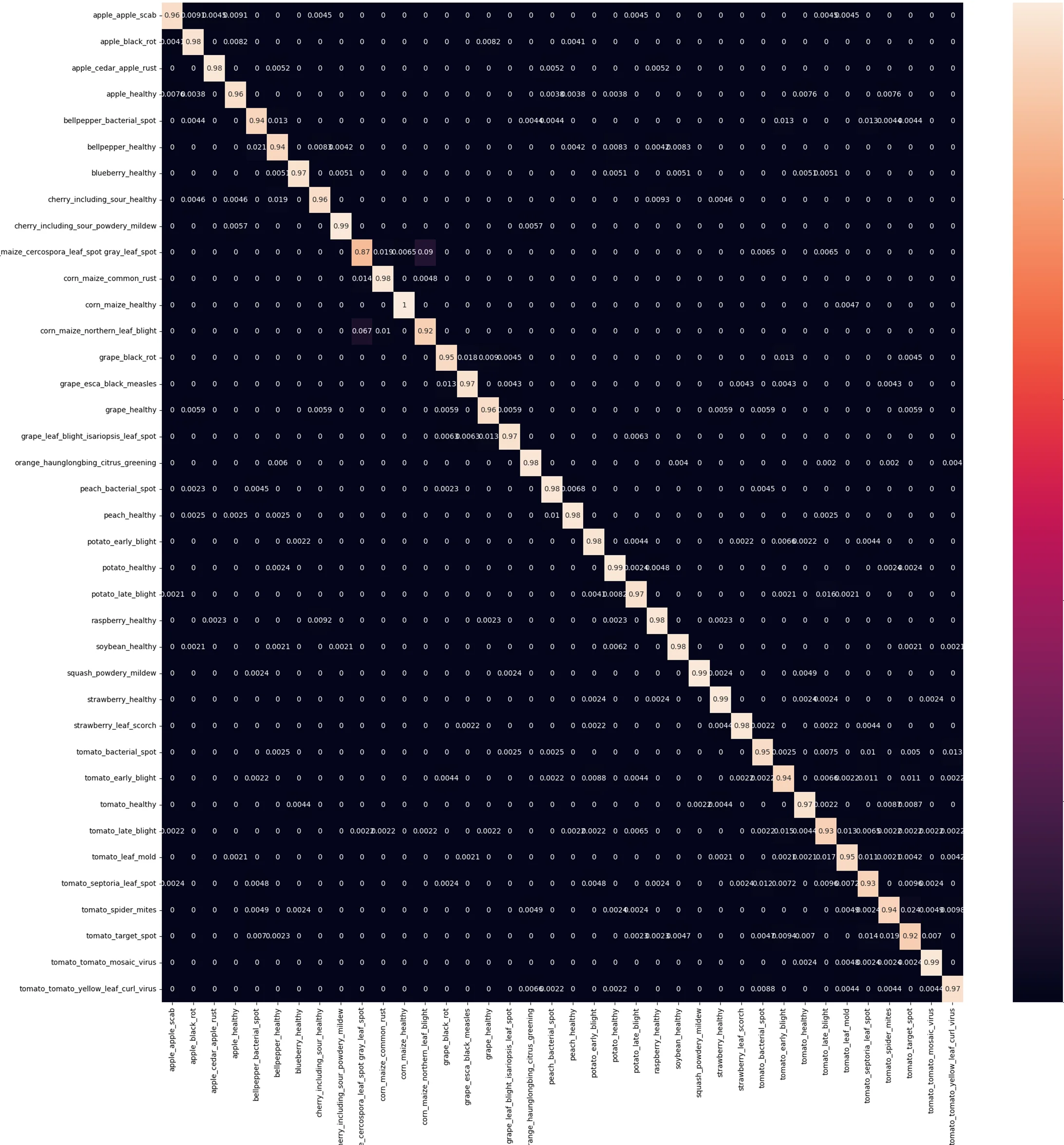
The matrix clearly shows:
- Which classes are recognized particularly well
- Where misclassifications occur
- How reliable the model performs overall
The Power of the Right Dataset
We used the Plant Diseases Kaggle Dataset, but quickly realized:
A model is only as good as the data it is trained on.
Some insights:
- The model performs excellently on similar datasets
- With completely new images (e.g., real field photos), variance is higher
- ⇒ Diversity in the training set is crucial
Our conclusion: Data augmentation and domain-specific additions are key factors for achieving good generalization.
Pretrained Models vs. Custom Architecture
We tested both pretrained models and custom-designed architectures.
| Approach | Advantages | Disadvantages |
|---|---|---|
| Pretrained | Fast start, fewer data needed, strong baseline performance | Models optimized for generic image classification |
| Custom | Fully tailored, complete control | More effort, extensive data collection needed |
Our final workflow combines both: pretrained models + targeted fine-tuning.
Future: Automated Agricultural Processes
We see the greatest potential in integrating our system into UAVs / drones:
- Automated field overflights
- Real-time analysis of plant conditions
- Automatic reports & early warning systems
- Precise, resource-efficient treatment
This technology enables a completely new approach in precision farming—measurably more efficient and sustainable.
Conclusion
Our project demonstrates how modern machine learning algorithms can help tackle global challenges in agriculture.
With an efficient model, a cleanly structured pipeline, and integration into automated systems, AI is becoming a central component of smart agriculture.
Bonus: Poster / Presentation Content
If you want to create an academic poster based on this project:
- Confusion Matrix
- Comparisons: EfficientNet vs MobileNetV2 vs ResNet
- Strategy: Pretrained Model + Fine-Tuning
- Hyperparameters: Learning Rate, Batch Size, Scheduler
- Own random test samples
- Result overview & workflow diagrams